Blog
March 7, 2024
Starlink vs. VSAT 2026: Why "Best Effort" is a Safety Risk for the Modern Superyacht
Blog
March 7, 2024
Starlink vs. VSAT 2026: Why "Best Effort" is a Safety Risk for the Modern Superyacht
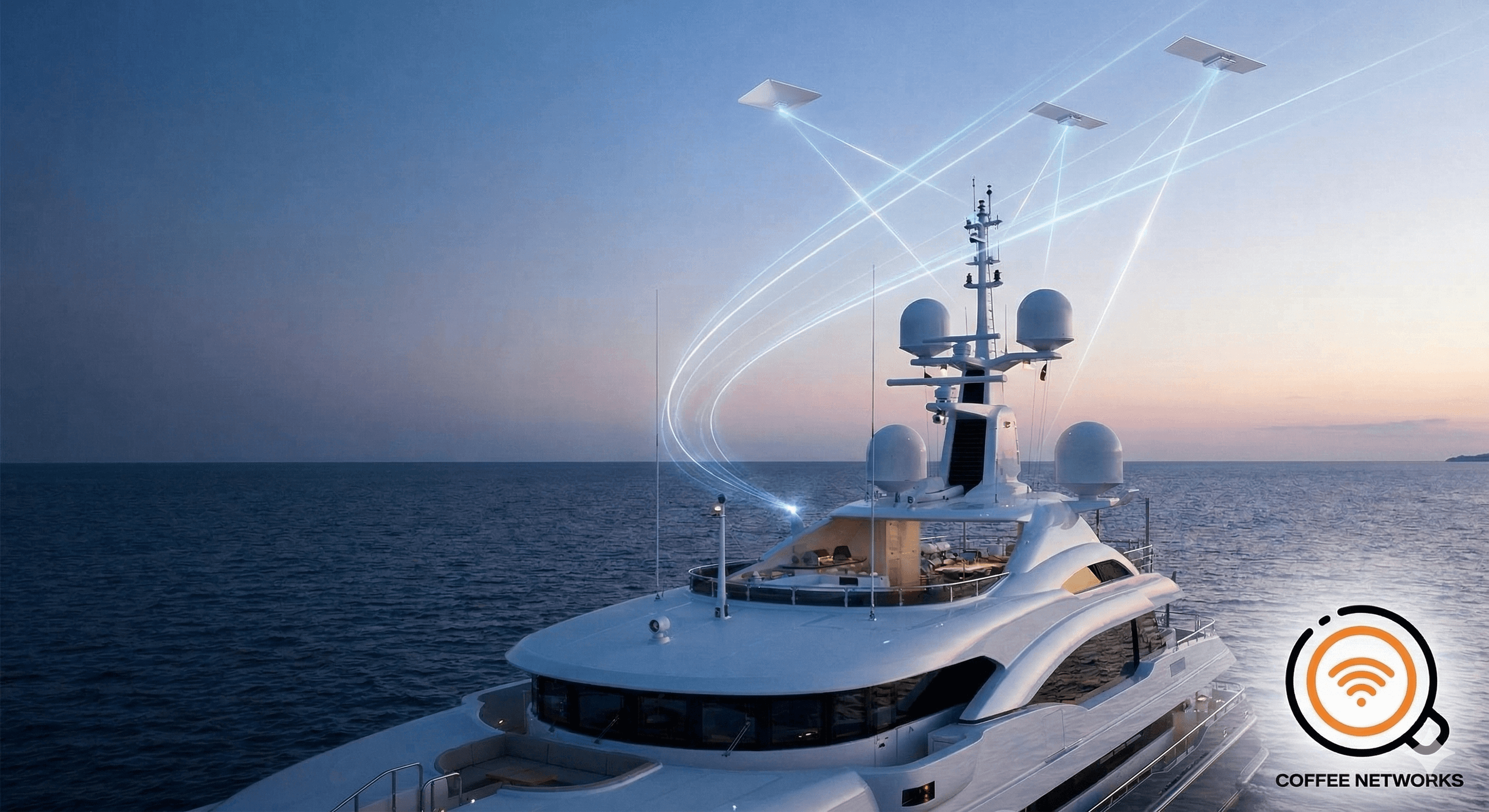
In 2026, Starlink is the standard for speed, but is it the standard for safety? As an unbiased MSP, we dive into why ‘Best Effort’ LEO services can leave a vessel vulnerable during high-risk transits. Discover why the world’s most secure superyachts are returning to a hybrid VSAT model to guarantee their lifeline when it matters most
In 2026, the conversation around yacht connectivity has shifted. We are no longer asking if Starlink works—we know it does, and it's fast. But as a Managed Service Provider (MSP) responsible for the operational integrity of some of the world’s most sophisticated vessels, Coffee Networks remains technology-agnostic. Our loyalty isn’t to a provider; it is to the vessel’s uptime.
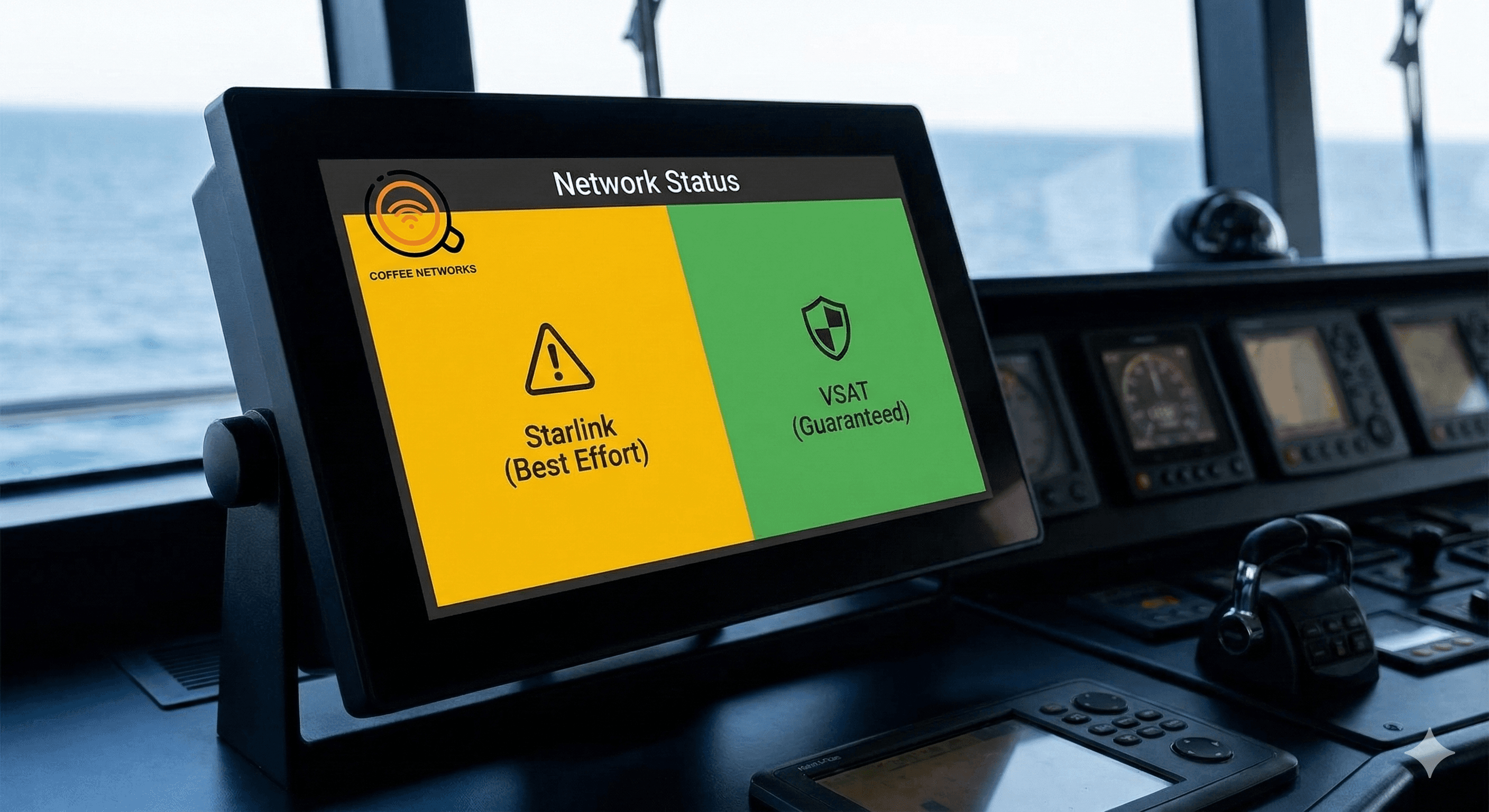
For the Captain and Chief Engineer, the decision between LEO (Starlink/OneWeb) and GEO (Traditional VSAT) is no longer just about Netflix speeds for the guests. It is about the fundamental difference between "Best Effort" and "Guaranteed Service."
1. The LEO Congestion Reality: When "Fast" Becomes "Fail"
The Mediterranean and Caribbean seasons of 2025/2026 have shown us the limits of LEO density. In high-traffic hubs like Monaco, Palma, or St. Barts, "Best Effort" services are exactly that—the satellite provider tries to give you speed, but you are competing with every other yacht in the marina.
When a LEO cell becomes congested, speeds can drop from 300Mbps to 5Mbps in seconds. For a guest's iPad, that’s an annoyance. For a Bridge system or a VoIP emergency call, it’s a failure.
2. The Critical Safety Case: High-Risk Transit & VoIP
This is where the debate moves from convenience to safety. When navigating through waters frequented by pirates or in areas of geopolitical instability, communication is not a luxury; it is a primary safety system.
· Geofencing & Regulatory "Blackouts": LEO providers are subject to shifting territorial landing rights. Service can cut the moment a vessel crosses a maritime border.
· The VSAT Lifeline: A VSAT connection with a Committed Information Rate (CIR) provides a guaranteed "pipe" that is always open. Even a 512kbps VSAT link ensures that VoIP, GMDSS, and emergency tracking remain online.
3. Thermal Management and Hardware Resilience
2026 has brought record-breaking temperatures. While flat-panel LEO hardware is sleek, we are seeing thermal throttling in extreme heat. Traditional VSAT domes remain the gold standard for long-range crossings due to superior mechanical reliability.
4. The "Hybrid" Winner: The Coffee Networks Standard
As an MSP, our recommendation for 2026 is clear: Resilience through Diversity.
We advise a "Hybrid Architecture":
· LEO (Starlink/OneWeb) for Audio Visual, and heavy data lifting.
· VSAT (GEO) for Bridge operations, VoIP, and emergency communications.
The Verdict
In 2026, Starlink is your entertainment. VSAT is your insurance. On a superyacht, you cannot afford to have one without the other.
In 2026, Starlink is the standard for speed, but is it the standard for safety? As an unbiased MSP, we dive into why ‘Best Effort’ LEO services can leave a vessel vulnerable during high-risk transits. Discover why the world’s most secure superyachts are returning to a hybrid VSAT model to guarantee their lifeline when it matters most
In 2026, the conversation around yacht connectivity has shifted. We are no longer asking if Starlink works—we know it does, and it's fast. But as a Managed Service Provider (MSP) responsible for the operational integrity of some of the world’s most sophisticated vessels, Coffee Networks remains technology-agnostic. Our loyalty isn’t to a provider; it is to the vessel’s uptime.
For the Captain and Chief Engineer, the decision between LEO (Starlink/OneWeb) and GEO (Traditional VSAT) is no longer just about Netflix speeds for the guests. It is about the fundamental difference between "Best Effort" and "Guaranteed Service."
1. The LEO Congestion Reality: When "Fast" Becomes "Fail"
The Mediterranean and Caribbean seasons of 2025/2026 have shown us the limits of LEO density. In high-traffic hubs like Monaco, Palma, or St. Barts, "Best Effort" services are exactly that—the satellite provider tries to give you speed, but you are competing with every other yacht in the marina.
When a LEO cell becomes congested, speeds can drop from 300Mbps to 5Mbps in seconds. For a guest's iPad, that’s an annoyance. For a Bridge system or a VoIP emergency call, it’s a failure.
2. The Critical Safety Case: High-Risk Transit & VoIP
This is where the debate moves from convenience to safety. When navigating through waters frequented by pirates or in areas of geopolitical instability, communication is not a luxury; it is a primary safety system.
· Geofencing & Regulatory "Blackouts": LEO providers are subject to shifting territorial landing rights. Service can cut the moment a vessel crosses a maritime border.
· The VSAT Lifeline: A VSAT connection with a Committed Information Rate (CIR) provides a guaranteed "pipe" that is always open. Even a 512kbps VSAT link ensures that VoIP, GMDSS, and emergency tracking remain online.
3. Thermal Management and Hardware Resilience
2026 has brought record-breaking temperatures. While flat-panel LEO hardware is sleek, we are seeing thermal throttling in extreme heat. Traditional VSAT domes remain the gold standard for long-range crossings due to superior mechanical reliability.
4. The "Hybrid" Winner: The Coffee Networks Standard
As an MSP, our recommendation for 2026 is clear: Resilience through Diversity.
We advise a "Hybrid Architecture":
· LEO (Starlink/OneWeb) for Audio Visual, and heavy data lifting.
· VSAT (GEO) for Bridge operations, VoIP, and emergency communications.
The Verdict
In 2026, Starlink is your entertainment. VSAT is your insurance. On a superyacht, you cannot afford to have one without the other.